Burial-Site Claims and Public Proof
Burial-Site Claims and the Missing Public Predicate
Burial sites deserve protection. That is exactly why MPRB must be precise, as different predicates require different evidence, legal authority, disclosure, and remedies.
This article is not trying to claim categorically that there are no burial concerns, archaeological resources, cultural resources, or Traditional Cultural Place concerns in or near Minnehaha OLDP, nor does it dispute the cultural importance of Bdóte, Mni Owe Sni / Coldwater Spring, or the surrounding landscape.
It does, however, make a public-record point: if MPRB is relying on burial-site law, it should say that clearly in nonconfidential terms. If MPRB is relying on archaeological sensitivity, Traditional Cultural Place incompatibility, ceremony, ecological restoration, adjacent-property conflict, or some other basis, it should say that too.
If MPRB identified a legally sufficient burial-site basis for decommissioning the Minnehaha Off-Leash Dog Park, it should say so6. However, if the public explanation has blurred different rationales: burial-site protection, archaeological sensitivity, Traditional Cultural Place significance, ceremony, spiritual concern, ecological management, and off-leash land-use conflict, this needs to be addressed as these issues are not the same thing legally. The remedy must match the actual predicate.
Minnesota burial law is specific
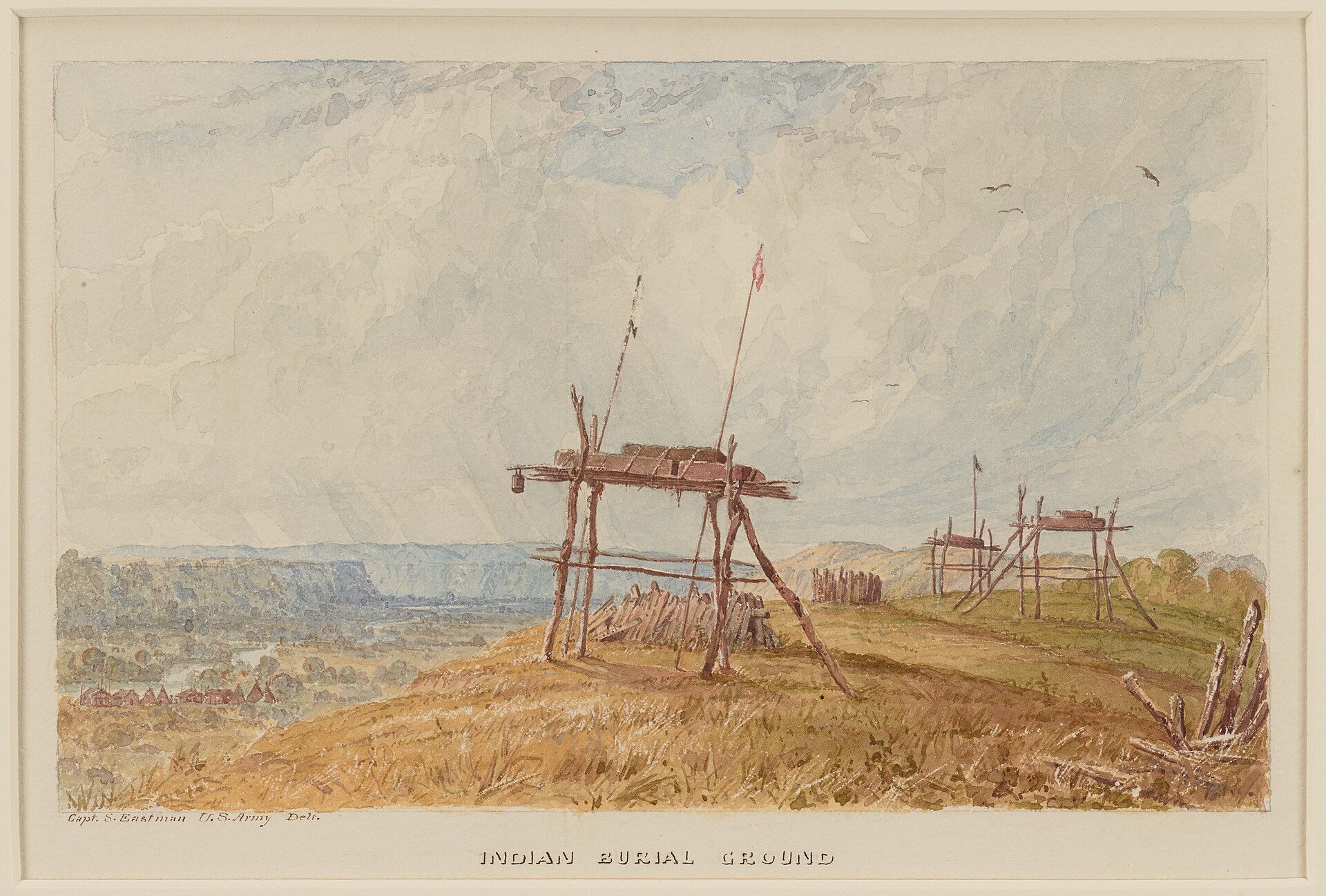
Indian Burial Ground, 1849–1855 (Seth Eastman). A painting showing a Dakota graveyard with elevated burial sites along the Minnesota River, above Fort Snelling. This historical image illustrates that burial-site claims are concrete, place-specific, culturally serious, and legally consequential, but with definable archaeological features that are well described in the historical record. Image source/credit9
Minnesota law protects human burials, human remains, and human burial grounds. It also creates a structure for assessment, appropriate authority, plan review, protection, and restricted access to sensitive burial-site data.134
That legal structure matters because it separates several different categories:
- Confirmed burial sites.
- Suspected burial sites.
- Assessed burial grounds.
- Unknown archaeological resources.
- Traditional Cultural Place significance.
- Sacred-landscape significance.
- Ceremony or prayer.
- Spiritual or ceremonial concerns about dogs.
- Visitor conflict or land-management incompatibility.
These concepts may overlap. They are not legally interchangeable.
Under Minnesota law, burial-site data under the authority of the Office of the State Archaeologist or the Minnesota Indian Affairs Council are treated as security information. Exact locations may properly be protected.1
But protected coordinates do not justify total public silence. Government data are presumed public unless classified otherwise, and if access is denied, the agency must cite the specific legal basis for withholding and certify the denial in writing on request.2
MPRB can protect sensitive location data while still disclosing segregable public conclusions.
What MPRB can disclose without exposing protected locations
MPRB does not need to publish confidential burial-site coordinates to answer basic public-record questions.
It can disclose, in nonconfidential terms:
Contact your ward commissioner and ask:
- Whether burial sites are confirmed, suspected, assessed, or merely not ruled out.
- Whether human remains were identified.
- Whether the Office of the State Archaeologist, Minnesota Indian Affairs Council, National Park Service, Minnesota Historical Society, consultants, or another authority made a determination.
- Whether the finding concerns burial sites, archaeological resources, Traditional Cultural Place significance, ceremony, spiritual concern, ecological management, or visitor conflict.
- What methods were used.
- What confidence level was assigned.
- What nonconfidential conclusions and recommendations were made.
- What alternatives were evaluated.
- Why decommissioning was selected over targeted protection.
That is the central transparency issue.
MPRB can protect exact locations and still disclose the nonconfidential basis for decommissioning.
The public archaeological record supports caution, not unexplained closure
The public 106 Group report is serious. It assessed the study area as having moderate-to-high potential for intact significant precontact and post-contact archaeological resources. It recommended avoiding impacts to known archaeological features where feasible. It also stated that no systematic survey of the entire study area had been conducted and recommended Phase I archaeological field survey in areas subject to project-related ground-disturbing activities before construction.5
That supports caution, further survey, avoidance, monitoring, buffers, and targeted protection.
Standing alone, it is not the same as a public burial-site determination requiring full decommissioning of the entire OLDP.
If MPRB has a separate burial-site determination, later consultant recommendation, OSA or MIAC assessment, NPS finding, legal memorandum, or management-zone conclusion supporting full decommissioning, it should disclose the segregable public portions and certify any withholding in writing.
If MPRB does not have that kind of determination, the public deserves to know that too.
The remedy must match the predicate
A confirmed or assessed burial ground may require serious restrictions: no disturbance, buffers, fencing, monitoring, altered maintenance practices, access limits, signage, or other site-specific protections.
A suspected burial site may justify interim restrictions, further assessment, monitoring, and protection against disturbance while the proper authority evaluates the site.
Archaeological sensitivity may justify survey, avoidance, monitoring, resource-management planning, erosion control, or restrictions on ground disturbance.
A Traditional Cultural Place concern may justify consultation, interpretation, cultural-resource planning, resource protection, boundary changes, or use rules.
A spiritual or ceremonial concern about dogs raises a different question. If MPRB's actual rationale is religious or ceremonial incompatibility with off-leash dogs rather than a disclosed secular resource-management finding, that issue belongs in the First Amendment Concerns analysis and should not be hidden inside burial-site language.
MPRB cannot convert uncertainty into inevitability.
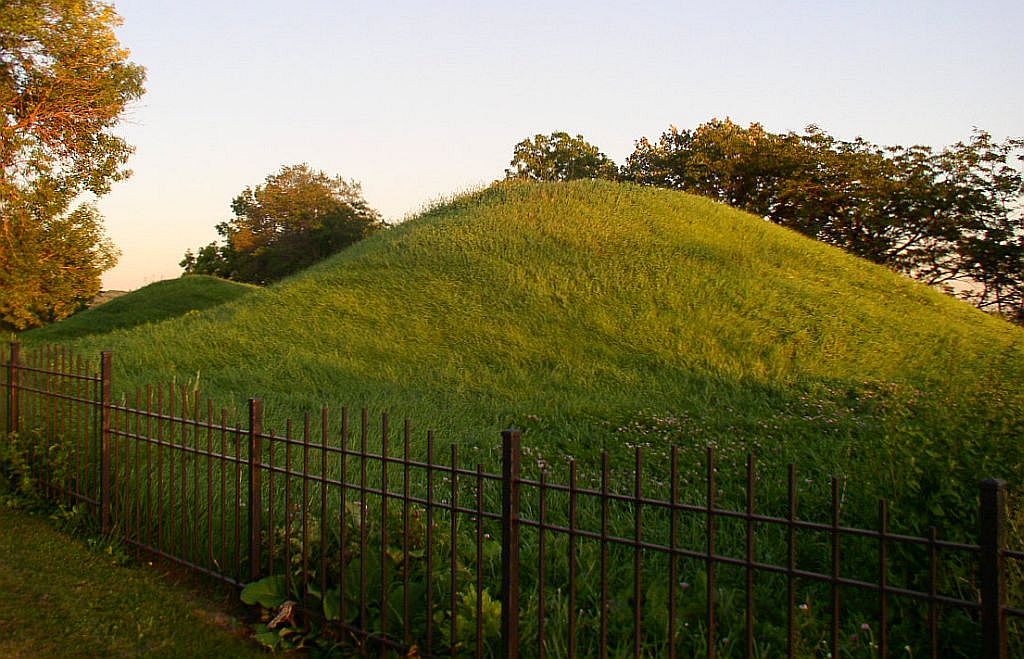
Wicaḣapi Indian Mounds Regional Park is a known sacred burial landscape and cemetery in Saint Paul. It remains public parkland because protection can be site-specific. That comparison matters. MPRB cannot invoke burial-site or sacred-landscape concerns as a shortcut to blanket closure unless it discloses the nonconfidential facts, legal authority, and alternatives analysis showing why Minnehaha supposedly cannot be managed the same way. Image source/credit810

Known burial landscapes can be managed through site-specific protections
Wicaḣapi / Indian Mounds Regional Park in Saint Paul is a known sacred burial place. The City of Saint Paul describes it as a cemetery and the only known remaining burial mounds within the Minneapolis-Saint Paul urban core. The park also remains a managed public park with amenities such as picnic areas, shelters, scenic overlook, playground, restrooms, and tennis courts.8
That comparison does not decide Minnehaha. The sites differ.
It shows a narrower principle: even where a burial landscape is known and sacred, the public agency must explain the management choice. The remedy should be tied to the specific site, specific risk, specific activity, specific jurisdiction, and specific legal obligation.
The physical record and jurisdiction still matter
The burial-site question cannot be separated from the physical history of the land.
The Physical Record page explains why the river-edge history matters: parts of the current recreational and visitor corridor appear tied to a dynamic Mississippi River edge shaped by channel movement, accretion, sandbar formation, shoreline change, floodplain conditions, and twentieth-century alteration.
That does not disprove burial sites.
It means generalized burial claims are not enough. If MPRB is relying on burial-site protection, the public needs to know how that claim was evaluated in light of landform, location, evidence, and jurisdiction.
Near the river is not the same as under the river.
A broad sacred landscape is not the same as a site-specific burial-site determination.
A sensitivity assessment is not the same as an alternatives analysis.
The River Access page addresses a related issue: the practical visitor footprint appears broader than the formal MPRB off-leash boundary and may involve MPRB land, federal land, shoreline, beach, ordinary-high-water issues, and the broader Mni Owe Sni landscape.
If the concern is on federal land, MPRB should explain its authority and coordination with the federal land manager. If the concern is on MPRB land, MPRB should identify the MPRB-controlled resource and the MPRB-specific remedy. If the concern is the entire broader cultural landscape, MPRB should say that directly and explain the legal and policy basis for removing a specific public amenity.
The chosen remedy must match the identified harm, landform, and jurisdiction.
Consultation is essential, but it is not a substitute for a decision record
MPRB should consult Dakota representatives, appropriate authorities, cultural-resource professionals, and other affected communities. That consultation is necessary.
But consultation does not eliminate MPRB's duty to create a public decision record, disclose what can lawfully be disclosed, identify the legal basis for withholding, analyze alternatives, and explain why decommissioning is necessary.
Recent reporting includes public statements about sacred land, burial concerns, religious freedom, and compromise.7
Those statements matter. They do not replace the agency's obligation to distinguish between burial-site protection, archaeological sensitivity, Traditional Cultural Place significance, ceremonial concern, and land-management policy.
A lawful and respectful process would protect genuinely sensitive information, disclose segregable public conclusions, acknowledge divergent views without flattening them, analyze targeted alternatives, and explain the final decision. The Decision Makers page addresses related public-authority and accountability questions.
Questions MPRB should answer before decommissioning
Before decommissioning Minnehaha OLDP, MPRB should answer these questions in public, nonconfidential terms:
Minimum public questions
- Burial-site status: Are burial sites or human remains confirmed, suspected, assessed, or not ruled out?
- Actual predicate: Is the basis burial protection, archaeological sensitivity, Traditional Cultural Place incompatibility, ceremony, ecological management, visitor conflict, adjacent-property conflict, or some combination?
- Legal authority: What statute, policy, regulation, recommendation, or land-management obligation does MPRB claim requires decommissioning?
- Decision-maker: Who made the relevant determination, and what role was played by OSA, MIAC, NPS, MNHS, consultants, staff, commissioners, or closed/private briefings?
- Site specificity: What land is implicated in generalized terms, and how does the finding account for historical topography, accreted riverbank, floodplain, former channel margin, bluff, terrace, shoreline, or upland?
- Jurisdiction: Is the concern on MPRB land, federal land, state-related land, riverbank, beach, ordinary-high-water area, or a broader cultural landscape?
- Remedy selection: Why is full decommissioning necessary instead of targeted protection, fencing, boundary reduction, leash-transition areas, restricted zones, seasonal or ceremonial-use restrictions, further survey, monitoring, partial closure, or a public hearing after disclosure?
- Disclosure: What records are being withheld, what portions are segregable, and what specific statutory, temporary-classification, or federal-law basis supports each withholding?
These are not hostile questions. They are the minimum questions required for public accountability.
Bottom line
Burial sites matter. That is why the public record must be precise.
If burial sites exist, they should be protected lawfully and specifically. If burial sites are suspected, MPRB should disclose the nonconfidential basis and complete the appropriate assessment. If unknown archaeological resources may exist, that risk should be managed through evidence-based alternatives. If the actual rationale is broader Traditional Cultural Place incompatibility, ceremony, or spiritual concern about dogs, MPRB should say so directly and address the separate legal and public-purpose questions.
Respect for burial sites requires law, evidence, process, and a remedy matched to the actual predicate.
Before implementation, MPRB should release the legally disclosable record, certify any withholding, identify the factual predicate, account for landform and jurisdiction, publish alternatives analysis, hold a public hearing after disclosure, and fund equivalent replacement access before Minnehaha OLDP access is lost.
Related pages
Sources
- Minnesota Statutes § 307.08, Private Cemeteries Act
- Minnesota Statutes § 13.03, Access to Government Data
- Minnesota Office of the State Archaeologist, Burial Sites Protection
- Minnesota Indian Affairs Council, MS 307.08 Minnesota Private Cemeteries Act
- 106 Group / MPRB, Archaeological Literature Review and Assessment for the Minnehaha Regional Park - Dog Park Fencing Project, Non-Confidential Version
- MPRB Resolution 2026-114
- WCCO/CBS Minnesota, "Minneapolis mulls closing Minnehaha Off-Leash Dog Park after discovering it sits on sacred tribal land," June 5, 2026
- City of Saint Paul, Wicaḣapi
- Minneapolis Institute of Art, Seth Eastman, "Indian Burial Ground," 1849-55; Wikimedia Commons, File:Dakota_Burial_Ground.jpg
- Wikimedia Commons, McGhiever, "IndianMoundsPark01.jpg," CC BY-SA 3.0 / GFDL
