First Amendment Concerns
Establishment Clause, Public Land, and Religious Neutrality
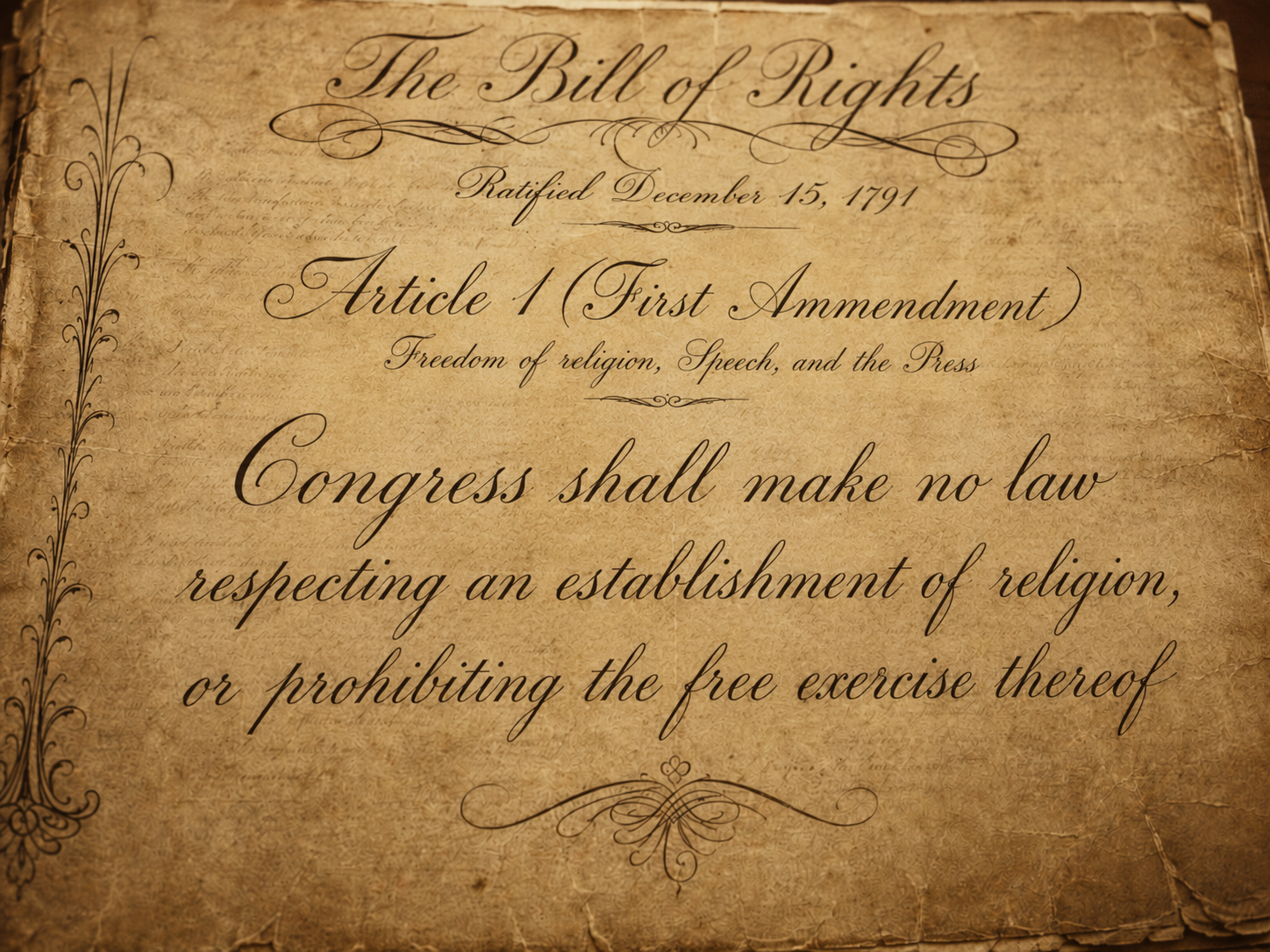
Public officials may respect religion. They may not use public land, public money, or public authority to establish, enforce, or privilege it.
This article raises constitutional concerns with MPRB's motivations to close the OLDP. Simultaneously, it does not challenge anyone's right to believe that Mni Owe Sni / Coldwater Spring is sacred. It does not deny the cultural, historical, spiritual, or religious importance of Bdóte, Coldwater Spring, or the broader Dakota landscape. It does not oppose lawful protection of burial sites, archaeological resources, Traditional Cultural Places, or culturally significant landscapes.
The issue it raises is possible impropriety of government action.
MPRB is not a private neighbor making a private accommodation. It is a public governmental body with taxing authority, land-management authority, enforcement authority, and stewardship obligations to the public at large.
If MPRB closes a longstanding public recreational use because of a disclosed secular land-management basis, (e.g., confirmed burial sites, human remains, archaeological resources, environmental harm, public safety, enforceable boundary problems, or another public-purpose ground) it should identify that basis and explain why decommissioning is necessary.
If MPRB cannot identify that basis, and the public record instead rests on sacredness, ceremony, prayer, spiritual incompatibility, or asserted "religious rights and needs," the Establishment Clause concern becomes direct.3
The Board's own record invokes spiritual and ceremonial grounds
Resolution 2026-114 does not read like an ordinary land-management resolution.
It invokes land of "historical, spiritual and personal significance." It cites MPRB commitments to reduce barriers to "traditional cultural practices." It refers to Mni Owe Sni as a "sacred area." It states that the off-leash recreation area is "incompatible" with Mni Owe Sni as a Traditional Cultural Place.1
The staff memorandum also ties the action to a Parks for All strategy involving Indigenous "cultural practices," "connections to land," "ceremony," "foraging," "land management," and interpretation.2
Those words matter.
They may support consultation. They may support interpretation. They may support cultural-resource planning. They may support careful management of a significant landscape.
But they do not, by themselves, establish a legal basis to remove a major public recreational use from public land.
The resolution does not state that burial sites have been confirmed. It does not state that human remains have been identified. It does not identify a mapped burial boundary. It does not state that Minn. Stat. § 307.08 requires decommissioning. It does not state that the Traditional Cultural Place designation legally requires closure. It does not explain why fencing, buffers, restricted zones, boundary reduction, enforcement, monitoring, further survey, partial closure, or replacement before closure are insufficient.18
That omission is central.
MPRB has put spiritual and ceremonial language into the official record, while failing to disclose a specific secular predicate for decommissioning.
President Olsen's statement moves the issue into constitutional territory
Park Board President Tom Olsen reportedly stated:
"While I am not a religious or spiritual person, I respect the religious rights and needs of all. Because of this principle, I have no other choice than to move forward with decommissioning the space as an off-leash dog park. It is a hard choice, but an easy decision."
That statement is legally significant.
It does not say:
- President Olsen has no other choice because confirmed burials were found.
- President Olsen has no other choice because human remains were authenticated.
- President Olsen has no other choice because an archaeological authority determined that decommissioning is required.
It says President Olsen has no other choice because of "religious rights and needs."
Public officials may respect religious rights. They should. Public officials may avoid unnecessary burdens on private religious exercise. They often may. But a public agency may not remove a public use from public land primarily because that use conflicts with one group's religious or spiritual needs unless it can identify a lawful secular basis for doing so.
The public is entitled to know whether MPRB is protecting a resource or enforcing a religious preference.
Government can protect burial sites. That is not the constitutional problem.
There is no serious dispute that government may protect human remains, burial grounds, archaeological resources, historic properties, Traditional Cultural Places, sensitive cultural landscapes, environmental resources, public safety, and access boundaries.
Government may protect
- Human remains.
- Burial grounds.
- Archaeological resources.
- Historic properties.
- Traditional Cultural Places.
- Sensitive cultural landscapes.
- Environmental resources.
- Public safety.
- Access boundaries.
Those are secular governmental purposes, even when the protected resource also has religious significance.
The constitutional problem arises when MPRB cannot identify the protected resource with enough specificity to justify the remedy, and the rationale instead becomes sacredness, prayer, ceremony, spiritual energy, or religious incompatibility with dogs.
That distinction is why the Burial Sites page matters.
If burial sites are confirmed, suspected, assessed, or legally protected, MPRB should disclose the nonconfidential basis and identify the authority, process, confidence level, and remedy.
If the public record shows only archaeological sensitivity or possible unknown resources, that may justify caution, survey, monitoring, avoidance of ground disturbance, buffers, fencing, restricted zones, signage, or further study.4
It does not automatically justify decommissioning a major public recreational use.
If MPRB has confirmed burial evidence, it should disclose that in nonconfidential terms. If it does not, it should not allow burial-site ambiguity to carry a decision that appears increasingly religious in substance.
The physical record makes the missing secular predicate more important
The topographic issue is not separate from the Establishment Clause issue.
It exposes the missing secular predicate.
Historical aerial images and mapping show that the present-day OLDP and surrounding visitor corridor sit within a dynamic Mississippi River edge shaped by changing channel margins, floodplain conditions, accretion, shoreline movement, sandbar formation, and twentieth-century landscape alteration.
Commissioner Garcia has reportedly acknowledged that the floodplain has changed through natural shifts and that assigning specific historical locations is difficult or unconfirmed.5
That matters.
While changing river geography does not automatically override cultural significance, it does raise the bar on what is required for evidentiary precision before closure. If MPRB cannot confidently identify the specific location, landform, jurisdiction, or resource concern, it cannot simply treat the modern OLDP boundary as though it maps onto a known cemetery or fixed sacred-use boundary.
The Physical Record page addresses this changing land-history problem in detail, and the River Access page addresses the related jurisdictional problems.
If the secular basis is uncertain, and the religious basis is explicit, the Establishment Clause concern becomes stronger, not weaker.
A Traditional Cultural Place designation is important, but not self-executing closure authority
Mni Owe Sni's designation as a Traditional Cultural Place matters.
It may support consultation, interpretation, cultural-resource protection, careful planning, and avoidance of unnecessary disturbance.
But a Traditional Cultural Place designation is not the same as
- A confirmed burial site.
- An authenticated cemetery.
- A mapped human-remains boundary.
- A legal mandate to decommission off-leash recreation.
- A license for government to enforce religious preferences.
A place can be culturally significant without every public use being unlawful.
A place can be sacred without every secular activity being prohibited.
A place can require careful management without requiring closure.
If MPRB believes the Traditional Cultural Place designation legally requires decommissioning, it should cite the authority that says so.
Otherwise, the designation is being used as a bridge from cultural significance to religious land-use control without the missing legal step.
Private religious exercise is protected. Government religious preference is not.
No one needs MPRB's permission to believe the land is sacred.
No one needs MPRB's permission to pray.
No one needs MPRB's permission to hold spiritual beliefs about Mni Owe Sni.
Public land can often accommodate religious expression on neutral terms with other public uses.
The issue is not private religious exercise.
The issue is whether MPRB may burden other public users by eliminating a longstanding recreational use because public officials conclude that the use conflicts with one group's religious or spiritual needs.
That is different.
A private person praying in a park is protected religious exercise.
A public agency closing a public amenity because dogs interfere with prayer is government action.
A tribal representative describing spiritual concerns is protected speech.
A commissioner voting to restrict public access because those religious concerns leave the commissioner "no other choice" is an exercise of state power.
That distinction is the heart of the issue.
Accommodation has limits
Government is not forbidden from accommodating religion.
But accommodation is not unlimited.
A valid accommodation must still respect neutrality, public burdens, and the rights of nonbeneficiaries. It cannot transfer a substantial public benefit to one religious use while imposing the full cost on other public users without a lawful public purpose.
That is what makes this case serious.
MPRB is not merely allowing ceremony.
MPRB is not merely providing interpretive signage.
MPRB is not merely preventing construction disturbance.
MPRB is not merely protecting a known burial mound.
MPRB is proposing to remove a unique, longstanding, taxpayer-supported, permit-supported public recreational use from public land.
That burden falls on nonbeneficiaries
- Residents.
- Off-leash permit holders.
- Renters and taxpayers.
- Disabled or elderly users who rely on the existing site.
- Dog owners who need a large natural-surface area.
- People who use the park for mental health, grief, community, and river access.
- The public that paid for a park system including this amenity.
If the Board is imposing that burden to protect a confirmed secular resource, it must identify the resource.
If it is imposing that burden to satisfy religious or spiritual objections to dogs, it must confront the constitutional problem directly.
The leashed-dog distinction shows why the predicate matters
Resolution 2026-114 appears to target off-leash use while allowing dogs to remain if leashed.1
That distinction may make sense under some secular theories.
If the concern is uncontrolled dogs entering National Park Service land, leashes, fencing, gates, and boundary enforcement are relevant.
If the concern is physical disturbance of specific resources, leashes, restricted areas, and monitoring may be relevant.
If the concern is visitor conflict, leashes and enforcement may be relevant.
But if the concern is that dogs interfere with prayers, absorb spiritual energy, desecrate sacred space, or are incompatible with ceremony, then the leashed-dog exception is much harder to explain.
A leashed dog is still a dog.
If the religious problem is dog presence, leash status does not solve it.
If leash status does solve it, then the real problem is control, enforcement, boundaries, or resource protection, not spiritual incompatibility.
MPRB cannot have it both ways. It must identify the actual problem.
Cemetery analogies require evidence
Some supporters of closure have compared the OLDP to cemeteries, graveyards, and sacred burial places.6
That analogy is powerful.
It is also potentially misleading.
If the OLDP contains confirmed burial sites, MPRB should say so in nonconfidential terms and disclose the authority, process, boundary, confidence level, and remedy.
If the OLDP does not contain confirmed or assessed burial sites, cemetery language may create a false public impression that closure is legally compelled by known graves.
This matters because the reported public record does not confirm burial sites. It identifies possible unknown archaeological resources.4
A possible unknown resource is not a cemetery.
A sacred landscape is not a mapped burial ground.
A religious belief about the land is not the same as statutory burial-site protection.
The constitutional analysis depends on the predicate.
Indigenous perspectives are not monolithic
The public record also shows that Indigenous perspectives are not uniform.
Some Indigenous voices support closure.
Others have questioned the claim that dogs are inherently disrespectful, observed that dogs were historically part of Dakota community life, or suggested that shared-use approaches at Wicaḣapi / Indian Mounds Park offer a better model.7
MPRB should not weaponize one Indigenous perspective against another.
But it also cannot treat one advisory position as a unified Indigenous mandate and then use that premise to justify closure without disclosure, alternatives analysis, or public hearing.
Divergent views do not weaken the need for cultural respect.
They strengthen the need for lawful process.
Where beliefs, histories, and public uses conflict, government must be especially careful not to convert one religious or spiritual view into public policy without a secular legal basis.
Public money makes the problem more serious
MPRB has independent taxing authority.
That matters.
If MPRB spends public money on studies, staff time, legal review, communications, implementation, enforcement, decommissioning, and replacement planning, the public is entitled to know what public purpose that money serves.
If public funds are being used to protect burial sites, MPRB should identify the nonconfidential basis.
If public funds are being used to protect archaeological resources, MPRB should identify the resource-management plan.
If public funds are being used to enforce leash boundaries, MPRB should identify the boundary and enforcement record.
If public funds are being used to remove a public use because it interferes with prayer, ceremony, sacredness, or religious needs, MPRB must provide public accounting that MPRB-levied tax dollars have not improperly been used to support or establish religious exercise.
That accounting is not optional.
It is the constitutional question.
The either-or test
This is the central test.
Either MPRB has a burial-site, archaeological-resource, environmental, safety, boundary-enforcement, or other secular land-management basis for decommissioning, in which case it must disclose the nonconfidential factual predicate, explain the methodology, account for changed river and floodplain topography, and justify why narrower remedies are insufficient;
Or it does not, in which case the formal resolution and public statements from Board leadership indicate that decommissioning may be driven by sacredness, ceremony, spiritual incompatibility, and asserted religious rights and needs. That requires public accounting for whether MPRB is using public land, public money, and public authority to support or establish religious exercise in a way that raises serious Establishment Clause concerns.
That is not rhetorical excess.
That is the logical consequence of MPRB's own record.
What MPRB must disclose
Before any decommissioning proceeds, MPRB should disclose the following in public, nonconfidential terms.
Secular basis and legal authority
- Whether burial sites or human remains are confirmed, suspected, assessed, or unconfirmed.
- Whether unknown archaeological resources are the only disclosed finding.
- Whether the concern is environmental, archaeological, ceremonial, religious, enforcement-related, or something else.
- Whether MPRB is relying on Minn. Stat. § 307.08, the Traditional Cultural Place designation, National Park Service recommendations, Native American Parks Council recommendations, religious rights, religious needs, or another legal authority.
- What legal authority requires decommissioning rather than targeted management.
Religious accommodation, alternatives, and public money
- Whose religious exercise is being accommodated, what burden was identified, and whether that burden was caused by government action or ordinary shared public use.
- Whether MPRB analyzed burdens imposed on nonbeneficiaries, neutral alternatives, shared-use management, and time, place, and manner accommodations for ceremony.
- Whether MPRB considered fencing, boundary demarcation, leash-transition areas, restricted zones, ceremonial-use scheduling, buffers, survey, monitoring, erosion protection, signage, enforcement, partial closure, seasonal restrictions, public education, and interagency coordination.
- How much has been spent, what funds were used, who approved expenditures, what future implementation will cost, whether replacement will be equivalent, and what accounting ensures MPRB taxes are not being used to establish, support, or enforce religious exercise.
What a lawful path would look like
A lawful path remains available.
MPRB should
- Suspend implementation.
- Release the nonconfidential record.
- Provide a redaction log.
- Certify any withheld data in writing.
- Identify whether burial sites are confirmed, suspected, assessed, or unconfirmed.
- Explain the legal authority for any burial-site or archaeological determination.
- Account for changed river and floodplain topography.
- Publish alternatives analysis.
- Hold a public hearing after disclosure.
- Analyze permit-holder impacts.
- Identify equivalent replacement capacity before access is lost.
- Account for public expenditures and Establishment Clause concerns.
If MPRB can justify decommissioning through a lawful secular basis, it should do so openly.
If it cannot, it should not ask the public to accept a religious rationale as a land-management mandate.
Conclusion: respect is not establishment
Respecting religion is lawful.
Establishing religion is not.
Protecting burial sites is lawful.
Invoking unconfirmed burial uncertainty while relying on prayer, ceremony, sacredness, and religious needs is not enough.
Consulting Indigenous stakeholders is appropriate.
Treating one spiritual position as a mandate to eliminate a public amenity without disclosure, public hearing, alternatives analysis, or equivalent replacement is not accountable governance.
The public does not need exact burial coordinates.
The public does need the factual predicate, the legal authority, the alternatives analysis, the public-money accounting, and the constitutional explanation.
MPRB can protect real resources.
It can accommodate religious practice on neutral terms.
It can manage public land with sensitivity and seriousness.
But it cannot use public land, public money, and public authority to remove a longstanding public use primarily because that use conflicts with religious or spiritual beliefs unless it can identify a lawful secular basis for doing so.
That is the separation of church and state issue.
And MPRB has not answered it.
Related pages
Sources
- MPRB Resolution 2026-114
- MPRB meeting materials for Resolution 2026-114 and related staff memorandum
- Legal Information Institute, First Amendment to the United States Constitution
- 106 Group / MPRB, Archaeological Literature Review and Assessment for the Minnehaha Regional Park - Dog Park Fencing Project, Non-Confidential Version
- Minnesota Star Tribune, Susan Du, "Minnehaha Dog Park users push for a say in the end of off-leash play," June 15, 2026
- FOX 9, Corin Hoggard, "Minneapolis parks board weighs closing Minnehaha dog park over Native sacred land," June 2, 2026
- Sahan Journal, Shubhanjana Das, "Minnehaha Off-Leash Dog Park may close amid efforts to restore sacred Dakota land," June 8, 2026, updated June 10, 2026
- Minnesota Statutes § 307.08, Private Cemeteries Act