Physical Record and Topography
Topography, River History, and the Missing Factual Predicate
This article seeks to make the point that: A dynamic river edge requires a site-specific explanation. While aerial, survey, and topographic record do not decide whether Mni Owe Sni / Coldwater Spring, burial sites, archaeological resources, or Traditional Cultural Place concerns deserve protection, they do provide a substantial physical record that shows why MPRB must be specific before decommissioning the entire Minnehaha Off-Leash Dog Park.
If MPRB is relying on burial-site protection, archaeological sensitivity, Traditional Cultural Place incompatibility, ecological harm, adjacent-property conflict, or some combination of those grounds, MPRB should identify the factual predicate and explain why full decommissioning is necessary.
Different predicates require different evidence, legal authority, disclosure, and remedies. A burial-site claim raises different questions than an archaeological-sensitivity finding, and both are different from a broader Traditional Cultural Place or ceremonial-incompatibility rationale.
That distinction is why the physical record matters.
The physical record raises a site-specific question
Historical aerial images from 1937, 1945, 1957, 1960, and 1970 appear to show a changing Mississippi River edge near the present-day dog park and visitor corridor: channel margins, beach, sandbar, accreted land, floodplain features, vegetation change, and shoreline movement.

This aerial record does not disprove archaeological resources, nor does it disprove burial concerns. However, it does make a blanket closure rationale harder to accept without a site-specific explanation with accompanying supporting physical evidence provisioned by the desk archaeological survey performed, or a justification for why a field survey was not required.
If MPRB is treating modern riverbank, beach, floodplain, accreted land, former channel margin, or heavily used shoreline areas as part of a closure-worthy cultural-resource area, it should explain how that conclusion accounts for the land's physical history.
That is especially important if MPRB is relying on burial-site law or burial-site protection. The public does not need protected coordinates, but it does need to know whether MPRB is relying on confirmed burials, suspected burials, archaeological sensitivity, or some broader cultural-landscape concern. The burial-site issue is addressed more fully on the Burial Sites page.
The public does not need confidential coordinates. The public does need nonconfidential conclusions, generalized management zones, methods, confidence levels, and reasons narrower remedies were rejected.
The public archaeological record supports caution, not unexplained closure
The public 106 Group report describes an archaeological literature review and desktop assessment prepared for the Minnehaha Dog Park fencing project. It assessed the study area as having moderate-to-high potential for intact significant archaeological resources and recommended avoiding known archaeological features where feasible.
It also states that no systematic survey of the entire study area had been conducted and recommends Phase I archaeological field survey in areas subject to project-related ground disturbance before construction.
That is a serious finding. It supports caution, further survey, avoidance, monitoring, buffers, and targeted protection. However, these findings alone are very much not the same as a public finding that the entire OLDP must be decommissioned.
If MPRB has stronger evidence, later recommendations, burial-site determinations, or management-zone findings supporting decommissioning, it should release the segregable public portions and certify any withholding in writing.
The visitor footprint is not the same as the legal boundary
The actual visitor-use corridor appears broader than the formal MPRB off-leash boundary. It includes river access, shoreline movement, adjacent land-management issues, and areas where NPS, MNHS, MPRB, and other authorities may have different roles.
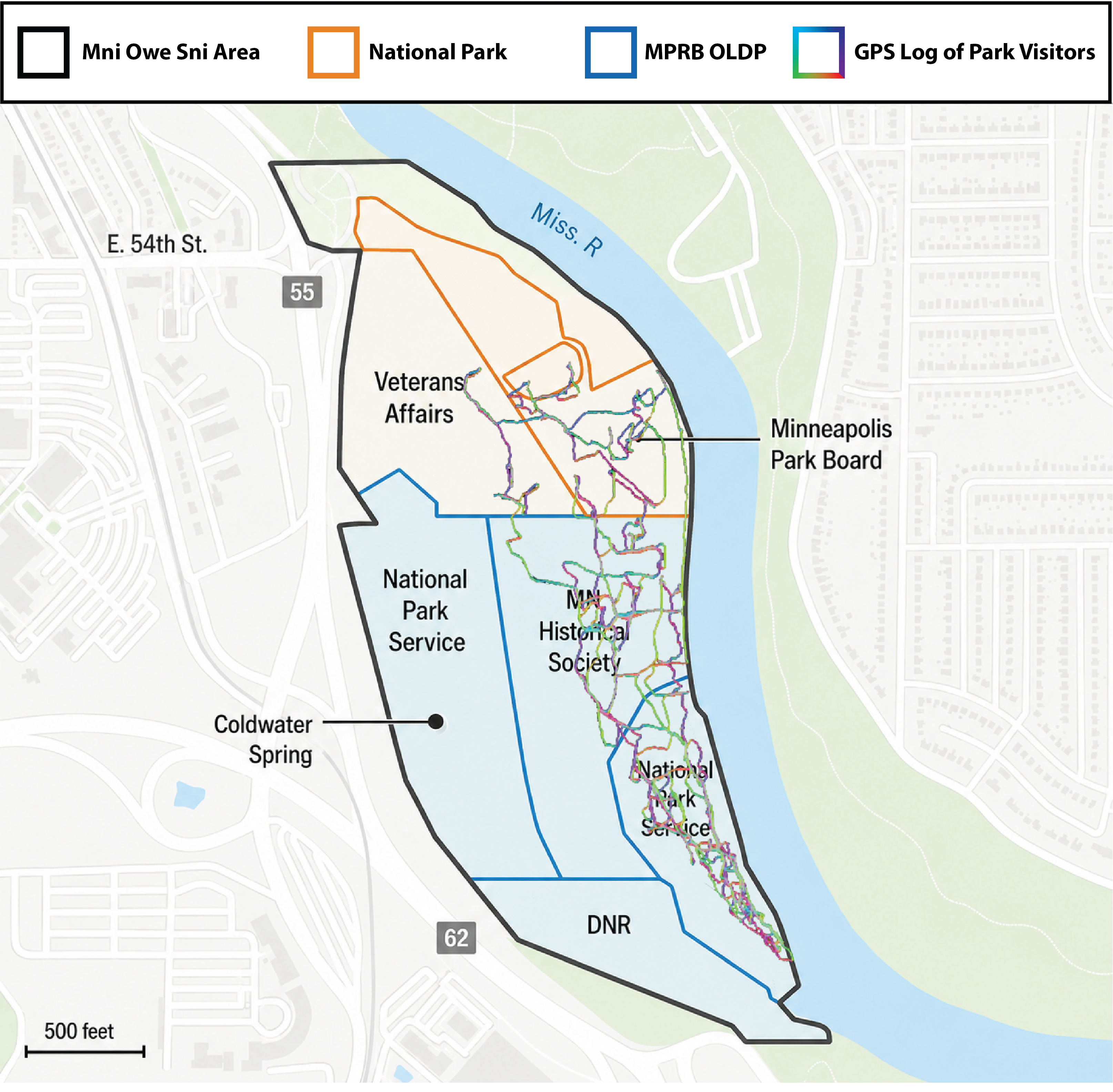
That matters because the remedy must match the problem.
If the problem is off-leash dogs crossing onto adjacent land, MPRB should explain why fencing, gates, signage, leash-transition areas, enforcement, and interagency management are insufficient.
If the problem is disturbance to specific archaeological or burial resources, MPRB should explain the protected area in nonconfidential terms and why buffers, restricted zones, monitoring, further survey, or boundary reduction are insufficient.
If the problem is broader Traditional Cultural Place incompatibility, MPRB should say that directly and release the nonconfidential findings and alternatives analysis supporting that policy judgment. If MPRB's rationale depends on spiritual, ceremonial, or religious incompatibility with dogs rather than a disclosed secular resource-management basis, that raises the religious-neutrality concerns addressed on the First Amendment Concerns page.
While this article makes no claims about permissiveness of off-leash activity on National Park Service land or whether dogs must comply with applicable leash rules and land-management regulations, the point it does raise is: if much of the conflict, use, or alleged impact occurs outside the formal MPRB off-leash boundary, MPRB must explain why decommissioning the OLDP is an effective, necessary, and proportionate remedy.
River engineering and shoreline change matter
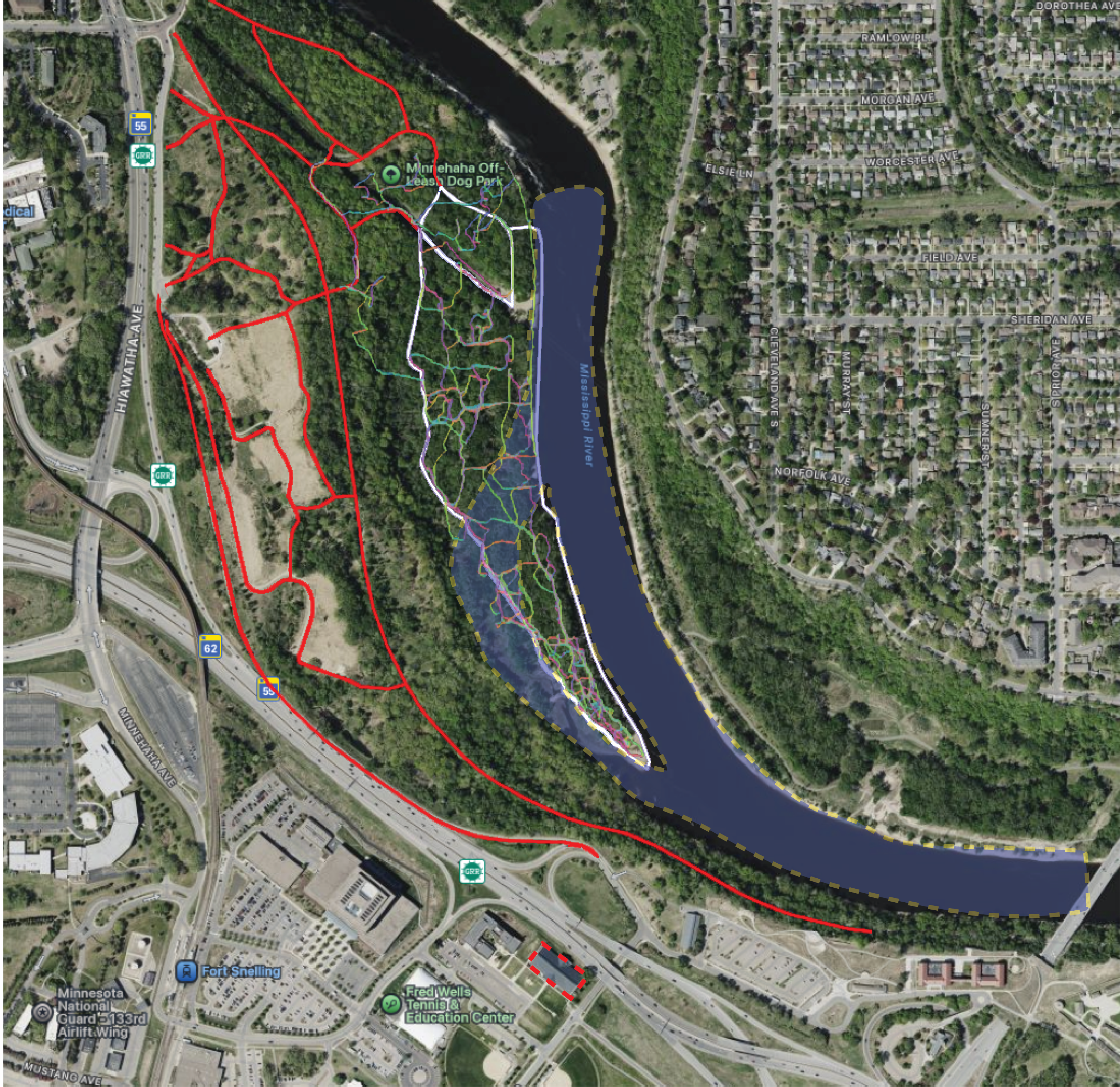
The modern OLDP sits in a Mississippi River corridor shaped by twentieth-century river engineering, including the Lock and Dam No. 1 / Ford Dam era.
That history does not eliminate cultural significance. It does not defeat Traditional Cultural Place significance. It does not prove the absence of archaeological resources. However, it does mean MPRB must distinguish between stable upland, bluff, terrace, floodplain, former channel, accreted land, beach, shoreline, ordinary high water, MPRB land, and adjacent non-MPRB land before choosing full decommissioning as the remedy. And in this remedy, the following must be accounted for:
- Near the river is not the same as under the river.
- A broad cultural landscape is not the same as a site-specific burial-site determination.
- A sensitivity assessment is not the same as an alternatives analysis.
Those distinctions also matter for replacement. If MPRB removes Minnehaha OLDP, the lost amenity is not just acreage; it is wooded terrain, shoreline access, beach access, river-adjacent use, and a particular regional location. The river-access and jurisdictional issues are addressed more fully on the River Access page.
Minimum disclosure questions
Before decommissioning, MPRB should answer these questions in public, nonconfidential terms:
Questions MPRB should answer
- What is the actual factual predicate for closure: confirmed burial sites, suspected burial sites, archaeological sensitivity, Traditional Cultural Place incompatibility, ecological harm, adjacent-property conflict, or something else?
- What land area is implicated in generalized terms: stable upland, bluff, terrace, floodplain, former river channel, accreted land, beach, shoreline, ordinary-high-water area, MPRB land, NPS land, MNHS land, or a broader cultural landscape?
- Who made the relevant determination, under what authority, using what methods?
- What confidence level was assigned?
- How does the determination account for historical river movement, shoreline change, floodplain conditions, accretion, and twentieth-century alteration?
- What alternatives were considered short of full decommissioning?
- Why were fencing, boundary reduction, protected zones, leash-transition areas, shoreline buffers, seasonal or event restrictions, monitoring, additional survey, partial closure, or relocation rejected?
- What nonconfidential recommendations did NPS, MNHS, Dakota representatives, consultants, staff, or legal counsel provide?
- What records are being withheld, what portions are segregable, and what specific legal basis supports each withholding?
These are not hostile questions. They are the minimum questions required for public accountability.
Bottom line
The maps do not answer every question.
They show why MPRB must answer them.
The physical record does not prove MPRB is wrong to protect sensitive places. It shows that MPRB has not disclosed enough to justify decommissioning first and explaining later.
Before implementation, MPRB should identify the factual predicate, account for the land history, disclose segregable public conclusions, analyze narrower alternatives, address river access and jurisdiction, explain any burial-site or Traditional Cultural Place basis in nonconfidential terms, and fund equivalent replacement capacity before Minnehaha OLDP access is lost.
Related pages
Sources
- 106 Group / MPRB, Archaeological Literature Review and Assessment for the Minnehaha Regional Park - Dog Park Fencing Project, Non-Confidential Version
- 106 Group, Supplementary Memo re: Traditional Cultural Places for the Minnehaha Regional Park - Dog Park Fencing Project
- MPRB Minnehaha Dog Park Perimeter Fencing project page
- MPRB Resolution 2026-114
- U.S. Army Corps of Engineers, Lock and Dam No. 1 history
- National Park Service, Lock and Dam No. 1 history
- Minnesota Statutes § 307.08, Private Cemeteries Act
- Minnesota Office of the State Archaeologist, Survey Manual
- Minnesota Geospatial Commons / Minnesota Historical Society, Original Public Land Survey Plats of Minnesota